Asa Winstanley
Middle East Monitor / July 9, 2020
Today marks 15 years since
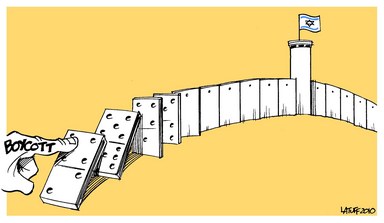
the official foundation of the Boycott, Divestment and Sanctions (BDS)
movement in Palestine. The movement against Israeli apartheid has a long
history and deep roots, but it was on 9 July 2005 that it was
established formally with the publication of the “Palestinian Civil Society Call for BDS”.
Endorsed by essentially all of Palestinian civil society – unions,
political parties, professional associations, women’s groups, human
rights organisations and religious and cultural associations – the
document called for a global BDS movement against Israeli’s violations
of Palestinian rights. It is modelled on the successful movement to
boycott apartheid South Africa, and is entirely peaceful.
The document is a key part of the history of the Palestinian
liberation struggle. It is most notable for its clarity and principles,
for making a set of three clear demands and for its unifying effect on
the Palestinian body politic.
“Fifty seven years after the state of Israel was built mainly on land
ethnically cleansed of its Palestinian owners,” it stated, “a majority
of Palestinians are refugees, most of whom are stateless. Moreover,
Israel’s entrenched system of racial discrimination against its own
Arab-Palestinian citizens remains intact.”
In this way, BDS raised global consciousness of the fact that the
Palestinians are, and have been since 1948, a diasporic people.
The settler-colonial Zionist movement’s expulsion of about 800,000
Palestinians in and around 1948 marked a stark break in Palestinian
history. The expulsion and dispersion of the Palestinian people endures
to this day, maintained by the racist state of Israel and its apartheid
regime.
Despite their legitimate right to do so, the refugees expelled by
Zionist militias since 1947 have never been allowed to return. This is
the central fact, and the core injustice, which the Palestinian
liberation struggle seeks to end.
Meanwhile, the Palestinians are divided physically between three
broad constituent groups: the Palestinian citizens of Israel (aka the
“Palestinians of ‘48”); those living under Israeli military occupation
in the West Bank and Gaza Strip, many of whom are also refugees from
their homes in what is now Israel; and other refugees who mostly live
beyond the borders of historic Palestine. The first two groups maintain
the Palestinian presence within their land — albeit not always their
traditional home areas — despite more than a century of Zionist efforts
to remove them.
The third group – the diaspora refugees – are the largest section of
the Palestinian people. There is some crossover with the three sectors:
many Palestinians in the West Bank and most
in the Gaza Strip are also registered refugees.
The
latest population estimates show that
there are 13 million Palestinians in the world today, five million of
whom live in the West Bank (including Jerusalem) and the Gaza Strip.
This leaves some eight million Palestinians living in the rest of the
world (including the two million who live within present-day Israel as
second or even third class citizens). The majority of Palestinians in
the world today are thus refugees; those expelled from their homes by
Zionist militias and the state of Israel since 1947, as well as their
descendants.
One of the most successful and insidious tools in the Israeli
colonial control kit has been that mainstay of imperialism: divide and
rule. In this way, Israel has attempted to impose divisions among the
Palestinian body politic in every way conceivable: religious, ethnic,
spacial and geographical, cultural and even sexual.
Some of these divisions have been successful, some have been total
failures (the attempt to divide Palestine’s Christian population from
its Muslim majority, for example) and others have had mixed results. But
the genius of the BDS call document was to reunite all of these sectors
back into one body politic, aided by the fact that the Palestinians
themselves have never accepted such divisions.
The BDS movement,
therefore, has raised the consciousness of the world that that
Palestinians are one people.
Too often during the era of the Oslo Accords, the phrase “the
Palestinians” referred only to those within the West Bank and the Gaza
Strip, an important sector no doubt, but a minority of the overall
population. Thus, for example, only those in the occupied Palestinian
territories were allowed to vote in elections for the Palestinian
Legislative Council and for the Palestinian Authority presidency.
The BDS efforts in this respect began in the preamble from which I
quoted earlier. It was, though, embodied more than anything in the three
demands of the BDS movement. These are key, because for any political
campaign to succeed, it must have concrete principles. Moreover, for any
boycott to win, it must not be open ended; it must have a goal in
sight.
The three demands of the BDS movement on Israel, as enshrined in the BDS document dated 9 July 2005, are:
- An end to the occupation (including Israeli occupation of other Arab lands, such as the Golan Heights);
- Full equality for everyone between the Jordan River and the Mediterranean Sea; and
- The realisation of the right of Palestinian refugees to return in line with UN resolution 194.
The first primarily addresses the rights denied to Palestinians in
the West Bank and Gaza Strip; the second concerns the rights denied to
Palestinian citizens of Israel; and the third addresses those at the
core of the matter: the Palestinian refugees. More than anything, these
demands by the BDS movement unite the three main groups of Palestinians
as noted above.
Over the course of the 15 years of the BDS movement, international
solidarity with the Palestinian struggle has faced many challenges and
many divisions. However, it remains broadly united on these three main
points. That has been the achievement of BDS. Above all else, it has
been the achievement of the Palestinian people themselves.
As
leading Palestinian intellectual Joseph Massad has put it,
the Palestinian people have stubbornly refused to capitulate, or to
concede that they are a conquered people destined for the dustbin of
history: they “have ‘missed every opportunity’ to recognise the right of
their oppressors to oppress them.”
Asa Winstanley is an investigative journalist living in London who writes about Palestine and the Middle East
https://palestina-komitee.nl/fifteen-years-of-bds-has-united-all-palestinians-and-their-supporters/