donderdag 27 juni 2019

BDS-oprichter Omar Barghouti over waarom een boycot tegen Israël?

Waarom en wanneer een boycot en wat heeft de BDS-beweging tot nu toe gerealiseerd, zo was de vraag aan BDS-oprichter Omar Barghouti in Ramallah.
 
Lees verder
https://www.dewereldmorgen.be/artikel/2019/05/09/bds-oprichter-omar-barghouti-over-waarom-een-boycot-tegen-israel/

Europese regeringen moeten de handel met de (alle illegaal) Israelische nederzettingen uitsluiten, volgens Europese vakbonden

European governments must ban trade with illegal Israeli settlements say major European trade unions

34 European trade union organisations representing millions of workers across Europe have written to the European Commission and European governments demanding a ban on trade with illegal Israeli settlements.

The EU considers Israeli settlements as illegal under international law, however it allows Israel to export large quantities of products produced or partly produced in illegal Israeli settlements to Europe and products from illegal settlements are widely sold by European retailers, providing direct economic support to the ongoing expansion of the settlements.

As highlighted in the recent ILO report Israeli settlement industry undermines Palestinian economy and workers’ rights. In 2013, public pressure and lobbying by Palestinian and European organisations led the EU to introduce a policy against providing funding for or allowing Israeli participation in EU projects, if such projects or participation effectively recognises Israeli sovereignty over occupied Palestinian and Syrian territory. However the EU has failed to take adequate action to meet its legal obligation to end trade with illegal Israeli settlements and to tackle the participation of European businesses in Israel’s settlement enterprise.

In his legal opinion released last week, Advocate General of the European Court of Justice said that European shops ought to label Israeli settler exports so that consumers can boycott them for « ethical » reasons the same way they did South African ones under apartheid.

“This opinion highlights the fact that European governments are falling short on their obligations under international law. In order to be consistent with its own legislation the EU and all European states should go further and end all economic relations with illegal Israeli settlements” – said Koen Vanbrabandt, a chair of the European Trade Union Network for Justice in Palestine that initiated the letter.

According to the signatories of the call, which includes an extensive list of trade unions, including some of the largest trade unions in Europe and together representing many millions of workers, the EU as a whole and all of its Member States individually have the obligation to withhold from trading with settlements as part of their duties of non-recognition and non-assistance.

The trade union movement has consistently called for a just solution to the Israeli-Palestinian conflict.

“The fundamental values of trade union internationalism mandates us to take concrete and effective action to facilitate the implementation of UN resolutions, international legal obligations, and a just and equitable peace for all” – the signatories say.

“It is in this spirit that we send out this call to the EU policy makers and European states to take effective action to bring an end to European complicity with human rights abuses associated with illegal Israeli settlements and to introduce a ban on economic activities with illegal Israeli settlements“ – the letter ends.


Further >
http://www.etun-palestine.org/site/2019/06/25/european-governments-must-ban-trade-with-illegal-israeli-settlements-say-major-european-trade-unions/

vrijdag 31 mei 2019

PalestineChronicle: Toegang tot schoon water is een mensenrecht, maar waarom is Palestina een uitzondering?


Access to Clean Water is a Human Right, so Why is Palestine an Exception?


Israeli forces confiscated meters of water pipes in the Jordan Valley. (Photo: Activestills.org)

Free access to clean water is a basic human right. This is not just a common-sense assertion, but also a binding legal commitment enshrined in international law.
In November 2002, the UN Committee on Economic, Social and Cultural Rights adopted “General Comment No. 15” regarding the right to water:
“The human right to water is indispensable for leading a life in human dignity. It is a prerequisite for the realisation of other human rights.” (Article I.1)
The discussion on water as a human right culminated years later in UN General Assembly resolution, 64/292 of 28 July 2010. It explicitly “recognizes the right to safe and clean drinking water and sanitation as a human right that is essential for the full enjoyment of life and all human rights.”
  
It all makes perfect sense. There can be no life without water. However, like every other human right, it seems, the Palestinians are denied this one too.
  
There is a water crisis affecting the whole world, and it is most pronounced in the Middle East. Climate change-linked droughts, unpredictable rainfall, lack of centralized planning, military conflicts and more have resulted in unprecedented water insecurity.
  
The situation is even more complicated in Palestine, though, where the water crisis is related directly to the more general political context of Israel’s occupation: apartheid, illegal Jewish settlements, siege and war. While much attention has rightly been given to the military aspect of the Israeli occupation, the state’s colonial policies involving water receive far less attention, but they are a pressing and critical problem.
  
Ashraf Amra Indeed, total water control was one of the first policies enacted by Israel after the establishment of the military regime following the occupation of East Jerusalem, the West Bank and Gaza Strip in June 1967. Israel’s discriminatory policies – its uses and abuses of Palestinian water resources – can be described as “water apartheid”.
  
Excessive Israeli water consumption; the erratic use of dams; and the denial of Palestinians of the right to their own water or the digging of new wells have all left vast and possibly irreversible environmental consequences. They have fundamentally altered the aquatic ecosystem altogether.
  
In the West Bank, Israel uses water to cement existing Palestinian dependency on the occupation. It uses a cruel form of economic dependency to keep Palestinians reliant and subordinate. This model is sustained through the control of borders, military checkpoints, collection of taxes, closures, military curfews and the denial of building permits. Water dependency is a centerpiece of this strategy.
  
The “Interim Agreement on the West Bank and the Gaza Strip”, known as the Oslo II Agreement, signed in Taba, Egypt in September 1995, crystallized the unfairness of Oslo I, which was signed in September 1993. Over 71 percent of Palestinian aquifer water was made available for Israeli use, with just 17 percent allocated for Palestinian use.
  
Even more appallingly, the new agreement invited a mechanism that forced Palestinians to buy their own water from Israel, further cementing the client-owner relationship between the Palestinian Authority and the occupying state.
  
Israel’s Mekorot water company, a wholly-owned government entity, misuses its privileges to reward and punish Palestinians as it sees fit. In the summer of 2016, for example, entire Palestinian communities in the occupied West Bank went without water because the PA failed to pay Israel massive sums of money to buy back water taken from Palestinian natural resources.
Bewildering, isn’t it? And yet many are still wondering why Oslo failed to deliver the much-coveted “peace”.
  
Look at the numbers in order to appreciate this water apartheid: Palestinians in the West Bank use about 72 liters of water per person per day, compared to 240-300 liters for Israelis. The political responsibilities of such unequal distribution of available water resources can be attributed to both the cruel Israeli occupation and the short-sighted vision of the Palestinian leadership.
  
The situation in Gaza is even worse. The territory will be officially “unliveable” by 2020, according to a UN report. That’s next year. The main reason for this grim prediction is Gaza’s water crisis.
  
According to a study conducted by international charity Oxfam, “Less than four percent of freshwater [in Gaza] is drinkable and the surrounding sea is polluted by sewage.” Oxfam researchers concluded that water pollution is dangerously linked to a dramatic increase in kidney problems in the Gaza Strip. Gaza’s water and sanitation crises are worsening as frequent shutdowns of the enclave’s only functioning power plant are killing any hope for a remedy.
  
The US-based RAND Corporation found that one-fourth of all diseases in the besieged Gaza Strip are waterborne. RAND estimations are no less dramatic. It reports that, based on the World Health Organisation (WHO) standards, 97 percent of Gaza’s water is not fit for human consumption. In terms of human suffering, this reality can only be described as horrific.
  
The hospitals in the Gaza Strip are trying to fight the massive epidemic of illness and disease caused by dirty water while underequipped, suffering electricity cuts and lacking any clean water themselves. “Water is frequently unavailable at Al-Shifa, the largest hospital in Gaza” the RAND report continues. “Even when it is available, doctors and nurses are unable to sterilize their hands to carry out surgery because of the water quality.”
  
According to the environmental media platform Circle of Blue, out of Gaza’s 2 million residents, only 10 percent have access to clean drinking water.
“My children get sick because of the water,” Madlain Al-Najjar, a mother of six living in the Gaza Strip, told Circle of Blue. “They suffer from vomiting and diarrhea. Often, I can tell that the water is not clean, but we have no other option.”
  
Britain’s Independent reported on the story of Noha Sais, a 27-year-old mother of five, living in Gaza. “In the summer of 2017, every one of Noha’s children suddenly fell ill, uncontrollably vomiting and were soon hospitalized. Gaza’s filthy Mediterranean waters had poisoned them.
“The youngest, Mohamed, normally a healthy and boisterous five-year-old, contracted an unknown virus from the sea, which took over his body and brain. Three days after the trip, he slipped into a coma. A week after that he died.”
Noha told the newspaper that,
“The doctors said the source of the infection was a germ that came from the polluted seawater, but they couldn’t work out exactly what it was. They just said to me even if my son recovered, he would never be the same – he would be a vegetable.”
Many similar cases are reported across Gaza, and there is no end in sight. Israel’s water policies are facets of a much larger war against the Palestinian people intended to reinforce its colonial control.
Judging by the evidence, Zionists didn’t “make the desert bloom,” as Israeli propaganda claims. Since its establishment on the ruins of more than five hundred Palestinian towns and villages destroyed between 1947 and 48, Israel has done the exact opposite.
  
“Palestine contains vast colonization potential which the Arabs neither need nor are qualified to exploit,” wrote one of Israel’s founding fathers and first Prime Minister, David Ben Gurion, to his son Amos in 1937. Zionist Israel, though, has done more than just “exploit” that “colonization potential”; it has also subjected historic Palestine to a relentless and cruel campaign of destruction that is yet to cease. This is likely to continue as long as Zionism prevails in Israel and occupied Palestine; it is a racist, hegemonic and exploitative ideology. If access to clean water is indeed a human right, why is the world allowing Israel to make Palestine and its people an exception?
  
– Ramzy Baroud is a journalist, author and editor of Palestine Chronicle. His last book is ‘The Last Earth: A Palestinian Story’ (Pluto Press, London). Baroud has a Ph.D. in Palestine Studies from the University of Exeter and was a Non-Resident Scholar at Orfalea Center for Global and International Studies, University of California Santa Barbara. His website is www.ramzybaroud.net

http://www.palestinechronicle.com/access-to-clean-water-is-a-human-right-so-why-is-palestine-an-exception/

dinsdag 28 mei 2019

PNN: Water, de zuiveringsinstallatie in Beit Jala (West Bank) vernield door Israel

Video: Israeli demolition of wastewater station leads to environmental disaster - PNN/ Bethlehem  
   
Israeli Occupation Forces on 13 February 2019  demolished a Wastewater Screening Station  and other Palestinian owned facilities in Bir ‘Ona area in Beit Jala town located south of Jerusalem, central West Bank.
  
The demolition, carried out without any prior notice by the Israeli municipality of Jerusalem, caused an environmental disaster and major financial losses.   According to the WSSA, the flow of wastewater into agricultural lands from the station caused damage to the olive planted lands owned by citizens, contamination to the ground wells, poisoning to the wild animals, odor emissions and rodents, while the financial losses were estimated at approximately 100,000 Euros.

The Bethlehem Water Supply and Sewage Authority (WSSA) said that its  administrative and technical staff  had no reports of the demolition consequences since Israeli Occupation Authorities (IOA) kept delaying their permits to access the site, located in area C of the West Bank, which falls under Israeli military and civil control. The authority also assured that the station has been owned by the Water Authority since 1993, and had received all the legal papers and permits for construction. However, Palestinians in the area still suffer from ongoing demolitions of homes and facilities.


Three weeks into research and contact with the Israeli Civil Administration for access, WSSA said it was shocked to find magnitude of the humanitarian disaster caused by the demolition, which was already based on illegal procedures.


The Water and Sewage Authority, following its visit to the site in coordination with the Palestinian Civil Association and representatives of Israeli bodies including the Civil Administration, the Environment and Nature Protection Authority and the Israeli Water Authority, confirmed that the demolition had already caused an environmental and health disaster, holding the Israeli municipality in occupied Jerusalem responsible for the demolition and reconstruction of the station.

The authority added that the municipality must bear its responsibility and reconstruct the station- which it demolished outside of the law. It also demanded to regain sovereignty over the station in order to run it properly, and demanded the Israeli occupation to facilitate the easement of WSSA’s employees and follow-up by the engineers, which would also require a major intervention from the Palestinian Civil Administration Office and stakeholders.


http://english.pnn.ps/2019/05/28/video-israeli-demolition-of-wastewater-station-leads-to-environmental-disaster/

vrijdag 17 mei 2019

Rightsforum: Wat zegt het Internationaal Recht over Israel/Palestina?

Schendingen

Anders dan een wijdverbreide voorstelling van zaken wil, is er in de kwestie-Palestina/Israël geen sprake van twee partijen die in vergelijkbare mate inbreuk maken op elkaars rechten. De kern van de kwestie is de Israëlische bezetting en kolonisering van Palestijns gebied, die gepaard gaat met schendingen van een scala aan rechten van de overheerste Palestijnse bevolking. Dat ook Palestijnen zich schuldig maken aan schendingen van het recht is evident, maar staat in geen verhouding tot de Israëlische onderdrukking van miljoenen Palestijnen op de Westelijke Jordaanoever, in Oost-Jeruzalem en in Gaza.


De bezetting: schending van het oorlogsrecht


De Israëlische rechtsschendingen hebben hoofdzakelijk betrekking op twee deelgebieden van het internationaal recht: de universele mensenrechten en het internationaal humanitair recht. Het internationaal humanitair recht is uitsluitend van toepassing op gewapende conflicten en wordt om die reden ook oorlogsrecht genoemd. Het is primair bedoeld om onnodig lijden te minimaliseren en bescherming te bieden aan personen die niet (meer) deelnemen aan vijandelijkheden, onder wie burgers die onder bezetting leven.

  
Onder dit recht heeft een bezettende mogendheid weliswaar bepaalde rechten, maar minstens zoveel plichten. Ze geldt als tijdelijk, ‘waarnemend’ bestuurder van het bezette gebied en dient de zaken in het gebied zoveel mogelijk bij het oude te laten. Het aanbrengen van permanente veranderingen is alleen toegestaan om dwingende militaire redenen of ten bate van de bevolking. Een bezetting doet geen afbreuk aan de soevereine rechten van de bewoners van het bezette gebied, en de bezetter dient zowel het internationaal recht als de plaatselijke rechtsregels in acht te nemen.
De bezetter is verder in hoge mate verantwoordelijk voor het welzijn van de bevolking. Hij dient onder andere de openbare orde en veiligheid te garanderen, voor levensmiddelen, medicijnen en medische faciliteiten te zorgen als daar gebrek aan bestaat, en mee te werken aan hulpverlening door externe partijen als die noodzakelijk is. Dit alles met bijzondere aandacht voor kwetsbare groepen binnen de samenleving, met name kinderen.
  
Het moge duidelijk zijn (zie het dossier De kwestie-Palestina/Israël) dat het Israëlische bezettingsregime zich weinig van deze verplichtingen aantrekt en alleen al met zijn grootschalige koloniseringsproject de Westoever en Oost-Jeruzalem in ieder opzicht van karakter verandert. Met zijn bezettingspolitiek schendt Israël dus (onder andere) het internationaal humanitair recht.
  
De Israëlische regering wijst vrijwel iedere verantwoordelijkheid af en stelt dat er eigenlijk geen sprake is van een bezetting. Ze betoogt dat Israël recht heeft op het bezette Palestijnse gebied, en dat de status daarvan dus niet die van ‘bezet gebied’, maar hooguit van ‘betwist gebied’ is. Deze voorstelling van zaken is van meet af aan verworpen door de internationale gemeenschap, en vindt alleen weerklank in kringen van wat ‘de bezettingslobby’ wordt genoemd: het internationale conglomeraat van politici, pressiegroepen en donoren dat stelt dat Israël (of preciezer: ‘het joodse volk’) om religieuze of ideologische redenen recht heeft op Palestijns gebied.

Van de EU tot de VS tot Nederland: zelfs onder de meest loyale bondgenoten van Israël is geen regering die beweert dat er geen bezetting is. En van de Veiligheidsraad tot de Algemene Vergadering tot de Mensenrechtenraad: alle relevante VN-organen hebben de Westoever, Oost-Jeruzalem en Gaza in reeksen resoluties als bezet gebied aangemerkt, en Israël keer op keer gewezen op zijn verplichtingen als bezettende mogendheid. 
Bovendien hebben ze Israël eraan herinnerd dat het op gewelddadige wijze verwerven van gebied in strijd is met het VN-Handvest, waaraan het als lid van de VN gebonden is en in de eigen Onafhankelijkheidsverklaring trouw heeft gezworen. In 2004 concludeerde het Internationaal Gerechtshof in zijn eerdergenoemde rapport over de Israëlische ‘Afscheidingsmuur’ op de Westoever ten overvloede dat ‘all these territories (including East Jerusalem) remain occupied territories and Israel has continued to have the status of occupying Power’.


In de Israëlische nederzetting Gilo gaat het bouwen door.
De Israëlische Afscheidingsmuur scheidt deze 
nederzetting van het Palestijnse Bethlehem op de Westbank. 
10 maart 2012. Ryan Rodrick Beiler / Shutterstock.com
 
Zie verder>

https://rightsforum.org/achtergronden/dossiers/internationaal-recht/kolonisatie-een-ernstige-schending/


En  om verder te lezen>
https://rightsforum.org/achtergronden/documentatie/boeken/ 

En zie ook>
May 15 – Al-Nakba (The Catastrophe) – 1948-2019

https://palestina-komitee.nl/?p=7558

donderdag 16 mei 2019

Al Haq: Al-Haq welcomes the first report to UNHRC by UN Special Rapporteur, Professor Michael Lynk, on the situation of human rights in the OPT Go to the profile of Al-Haq | Palestine

 
(Jerusalem, March 27, 2017) — Al-Haq welcomes the first report to the Human Rights Council by the UN Special Rapporteur on the situation of human rights in the OPT, Professor Michael Lynk. In his report (PDF), the Special Rapporteur calls on Israel to bring a complete end to its 50 year occupation of the Palestinian territory and honour the rights of human rights defenders in the OPT. Professor Lynk called on Israel to end the use of criminal, legal, and security tools to obstruct the legitimate work of human rights defenders, including the use of arbitrary arrests and detentions, and to repeal all restrictive legislation targeting human rights defenders.
  
As highlighted in the report, civil society organizations and human rights defenders across the OPT and Israel, including Al-Haq, have faced repeated attacks aimed at undermining our important and necessary work, but we remain steadfast in pursuing our missions.
“Al-Haq, a leading Palestinian human rights organization, has endured a grievous pattern of threats, cyber-attacks and a campaign of attempted interference; with their work by persons unknown. Beginning in the autumn of 2015 and continuing into 2016, a series of detailed letters by either anonymous or impersonating individuals were sent to donors and partners of Al-Haq, purporting to raise serious concerns about fraud, corruption, financial disarray, lack of transparency and organizational disunity at the organization. Al-Haq was required to expend considerable resources refuting the unfounded allegations, including having its auditors — Ernst & Young — assure the partners and donors that there has been no financial or institutional malfeasance. Other messages contained explicit threats to the lives or well-being of various Al-Haq employees, including its General Director, Shawan Jabarin.” — Page 12 of the report


Front Line Defenders, 2016

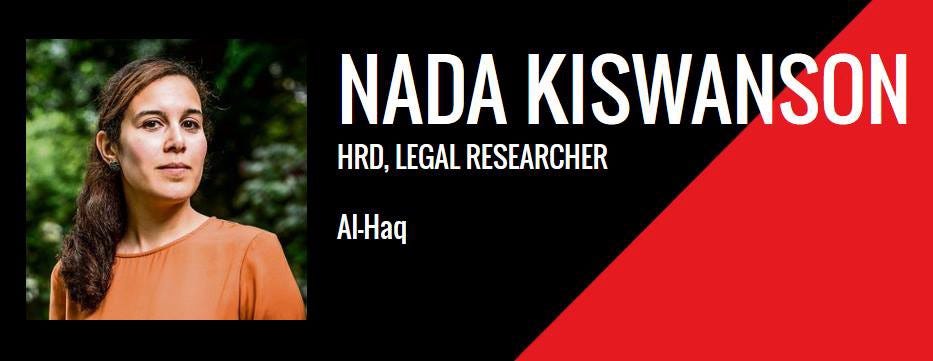
“One highly illustrative and disturbing example of the current climate was the series of sophisticated death threats and menacing accusations issued to Ms. Nada Kiswanson, a human rights lawyer in The Hague, The Netherlands, where she represents Al-Haq and other human rights defenders in Europe and before the International Criminal Court (ICC). Beginning in February 2016 and intensifying over the following months, Ms. Kiswanson received multiple phone and email messages to private numbers and encrypted message services — some of them anonymous, others from individuals impersonating governmental, intergovernmental and international organizations — stating that she would be “eliminated”, she was “not safe at all and hopefully this would remain”, and “Honey, you are in grave danger. You have to stop what you are doing.” Thousands of fabricated leaflets with Al-Haq’s logo were distributed to homes in Ms. Kiswanson’s neighborhood, describing Al-Haq as an organization “working to strengthen the Islamic base in the country,” and asking for financial donations to be delivered to her home address.
Funeral flowers were left in front of her house. Amnesty International stated that it had to temporarily shutter its office in The Hague, after one of its employee’s email accounts had been hacked as a means of sending threats to Ms. Kiswanson. The Observatory for the Protection of Human Rights Defenders noted that these attacks demonstrated a high level of technological sophistication and financial backing. To date, police in the Netherlands have investigated the threats and have provided protection for Ms. Kiswanson, but they have been unable to locate their source. This is the first known attack on Dutch soil against a human rights defender working on ICC issues.” — pages 14 & 15 of the report

 
https://medium.com/@AlHaq.EN/al-haq-welcomes-the-first-report-to-unhrc-by-un-special-rapporteur-professor-michael-lynk-on-the-fd91f21f001d 

Al-Haq welcomes the first report to UNHRC by UN Special Rapporteur, Professor Michael Lynk, on the situation of human rights in the OPT

Go to the profile of Al-Haq | Palestine

woensdag 15 mei 2019

Nederlands Palestina Komitee: 'transfer' en verdrijving –lees: etnische zuivering –als bepleit door kopstukken binnen de zionistische beweging

Theodor Herzl-architect of contemporary Zionism.

'When we occupy the land, we shall bring immediate benefits to the state [Turkey] that receives us. We must expropriate gently the private property on the estates assigned to us. We shall try to spirit the penniless population across the border by procuring employment for it in the transit countries, while denying it any employment in our own country.' 


(12 June, 1895; in: Raphael Patai, ed., The Complete Diaries of Theodor Herzl; Volume 1; translated by Harry Zohn; New York, Herzl Press & T. Yoseloff, 1960; pp. 88-89).  


Etcetera........

https://palestina-komitee.nl/wp-content/uploads/2017/11/transfer-en-verdrijving.pdf


--------------------------------------

 Bovenstaande citaten zijn verzameld door de Palestijnse wetenschapper Nur Masalha (School of Theology, Philosophy, and History van het St Mary's University College; Twickenham, Groot-Brittannië), auteur van Expulsion of the Palestinians -The concept of 'Transfer' in Zionist Political Thought, 1882-1948; Washington, Institute for Palestine Studies, 1992; 235 pp.; A Land without a People -Israel, Transfer and the Palestinians, 1949-96; Londen, Faber & Faber, 1997; 246 pp.; en van Imperial Israel -The Politics of Expansion; Londen, Pluto Press, 2000; 279pp.